


Why Sensory Marketing Will Define 2026 (And Why Luxury Brands Already Understand It)
- JUDE™

- Mar 1
- 7 min read
In 2026, the brands that lead will not be the loudest, they will be the ones that are felt.
For the past decade, visual excellence has defined strong branding. Clean typography. Controlled colour systems. Perfectly lit campaign imagery. Aesthetic refinement became synonymous with credibility, but artificial intelligence has changed the production landscape.
High-quality visuals are no longer scarce. They are generated instantly. Polished campaigns can be replicated at scale. As content velocity accelerates across Instagram, TikTok, paid media and AI-driven search environments, visual perfection becomes baseline rather than differentiator.
When everything looks good, looking good is no longer enough. This is where sensory marketing becomes strategically significant - particularly for brands investing in luxury brand strategy and long-term positioning. Not as a trend or as an aesthetic flourish but as a structural shift in how brands create memory, differentiation and long-term value.

What Is Sensory Marketing? (Definition & Strategic Context)
Sensory marketing is a branding strategy that engages sight, sound, touch, scent, temperature and scale to influence perception, emotional response and purchasing behaviour. It extends branding beyond visual identity into embodied experience.
Rather than presenting a product as an image, sensory marketing constructs an atmosphere around it. Texture implies quality. Weight implies value. Warmth implies intimacy. Protection implies rarity. Softness implies comfort.
When multiple senses are activated, neural encoding strengthens. That means stronger recall, deeper emotional attachment and higher perceived value.
Sensory marketing moves branding from something viewed to something experienced and in 2026, that distinction matters more than ever.
Why Sensory Marketing Will Dominate Marketing Strategy in 2026
Search behaviour is already shifting.
Interest in:
experiential marketing strategy
immersive brand experience
luxury branding strategy
marketing trends 2026
AI and marketing automation
brand differentiation in saturated markets
is increasing as brands attempt to compete in oversaturated digital ecosystems.
AI has removed friction from visual production. Campaign mock-ups, brand assets and polished imagery can be created instantly but what AI struggles to replicate is embodied context, atmosphere, material tension, ritual, environmental storytelling and psychological cues.
As feeds become saturated with visual output, brands relying solely on aesthetics will blend into the noise. Sensory branding introduces depth, which is something harder to automate and harder to replicate. In an era defined by infinite content, sensation becomes strategic advantage.
Examples of Sensory Marketing in Luxury Branding
To understand why sensory marketing works, we need to look beyond “creative visuals” and examine psychological mechanics.
RHODE — Warmth, Ritual & Daily Intimacy
When RHODE stamps its logo into warm bread, the gesture appears playful. Strategically, it is tactile alignment.
Bread carries subconscious associations of warmth, nourishment, daily routine and domestic familiarity. Skincare depends on ritual and intimacy. By embedding the logo into something edible and comforting, RHODE aligns itself with softness and habit formation without showing product texture explicitly.
The brand shifts from cosmetic packaging to sensory ritual which increases memorability - and routine drives repeat purchase. This is sensory marketing through warmth and familiarity.

JACQUEMUS — Protection, Atmosphere & Environmental Storytelling
Jacquemus frequently constructs immersive environments rather than isolated product shots.
In the umbrella installation, falling rain introduces movement and implied sound. The umbrellas shield the bag, subconsciously positioning it as precious and worthy of protection. Rain suggests vulnerability and shelter suggests care. Protection is a powerful luxury cue. When something appears safeguarded, it feels rare.
The scale distortion amplifies perceived importance and the product becomes central within a constructed world. This is sensory marketing through environmental tension and narrative value signalling.

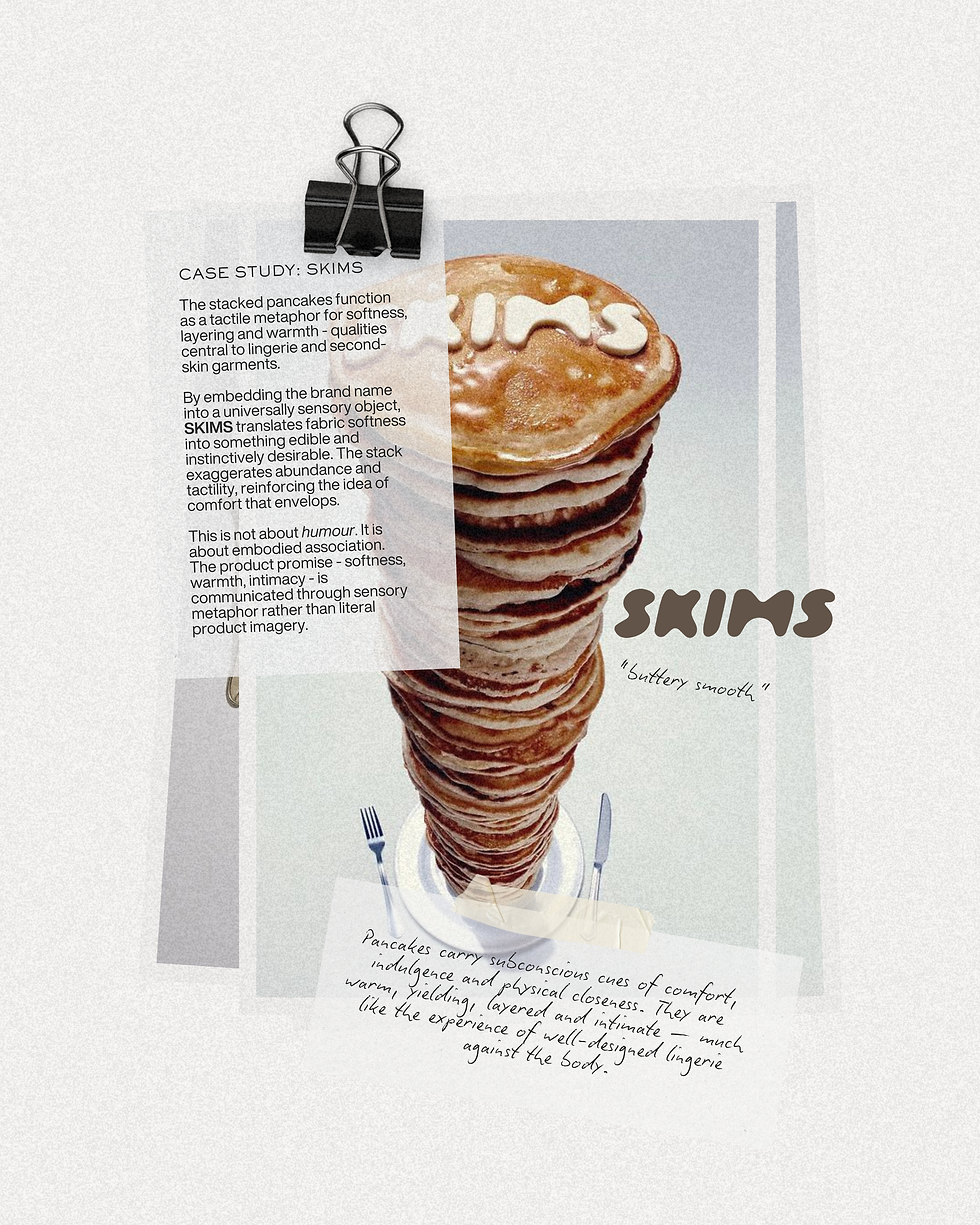
SKIMS — Softness, Appetite & Intimacy
By embedding its logo into a stack of pancakes, SKIMS translates softness into appetite.
Pancakes carry associations of warmth, layering, indulgence and tactility, qualities aligned with lingerie and second-skin garments. The metaphor reinforces product promise through embodied association. Comfort becomes edible and intimacy becomes shareable.
This is experiential marketing strategy expressed through sensory metaphor.
ALOHAS — Desire as Consumption
When ALOHAS presents shoes within a dining ritual, it equates fashion with appetite.
Dining involves anticipation, texture, atmosphere and indulgence. By positioning footwear as something served, the brand reframes desire as consumption. Luxury brands frequently rely on appetite psychology. Framing product as indulgence increases perceived desirability.
This is multi-sensory branding operating through conceptual metaphor.

The Strategic Objectives of Sensory Marketing
Sensory marketing is not decorative. It serves clear commercial objectives:
Increase brand recall
Strengthen emotional response
Elevate perceived value
Encourage organic shareability
Deepen differentiation in saturated markets
From an SEO perspective, stronger emotional engagement often correlates with:
Increased dwell time
Higher branded search volume
Improved direct traffic
Stronger conversion rates
Search engines increasingly prioritise contextual depth and user engagement signals. Brands that create sensory narratives often see stronger long-term brand equity, which supports search performance indirectly. This is where branding strategy and SEO intersect.
How to Use Sensory Marketing in Your Brand Strategy
Sensory marketing does not require large-scale installations. It requires structured perception.
To integrate sensory branding effectively:
Identify your core product sensation (softness, temperature, weight, scent, atmosphere).
Translate that sensation into metaphor or environment.
Ensure brand identity reflects material integrity.
Align digital experience with physical promise.
Reinforce sensory cues consistently across platforms.
For hospitality brands and hotels looking to reduce reliance on OTAs, sensory branding strengthens emotional connection - something we explore in Reducing OTA Dependency: A Direct Booking Strategy for Hotels. This might mean translating room atmosphere into digital storytelling.
For wellness clinics, it might involve emphasising tactility and restoration. For luxury retail, materiality and protection cues become central. The objective is coherence between physical experience and brand communication.
Sensory Marketing, AI & The Future of Search
With years of combined experience in SEO and search strategy, one pattern remains consistent: Search engines reward authority rooted in experience. AI Overviews and semantic search environments prioritise clarity, context and layered understanding.
Content that demonstrates experiential expertise, rather than surface-level commentary, is more likely to surface in AI-generated summaries.
Optimising for AI in 2026 means:
Clear definitions
Structured hierarchy
Contextual depth
Strategic examples
Semantic richness
Sensory marketing content naturally lends itself to contextual depth, making it valuable for both human readers and AI-driven retrieval systems. As AI accelerates content creation, authenticity and embodied experience become harder to replicate - and therefore more valuable.
The Shift From Visual Economy to Experiential Economy
For years, marketing operated within a visual economy, now we are entering an experiential economy. Visual saturation is accelerating and experiential depth remains scarce. Brands that construct atmosphere, tension and ritual create stronger memory encoding and long-term equity.
Aesthetic alone is scalable. Atmosphere is not.
Sensory marketing will define 2026 because it offers insulation against sameness.
Frequently Asked Questions
What is sensory marketing in simple terms?
Sensory marketing is a branding strategy that engages one or more of the five senses - sight, sound, touch, taste or scent - to influence how a brand is perceived and remembered.
Rather than relying solely on visual design, sensory marketing creates atmosphere, texture and emotional context around a product or service. By activating multiple sensory cues, brands increase memory retention and emotional attachment, which can influence purchasing behaviour.
In 2026, sensory marketing is increasingly used to differentiate brands in saturated digital environments.
How does sensory marketing improve brand recall?
Sensory marketing improves brand recall by strengthening neural encoding.
When multiple senses are activated - for example, through texture metaphors, environmental storytelling or implied sound and temperature - the brain forms stronger associative memory networks. This makes the brand more memorable compared to purely visual content.
Luxury and hospitality brands often use sensory branding to create deeper emotional attachment, which leads to increased branded search, stronger loyalty and higher lifetime value.
What are examples of sensory marketing in luxury branding?
Examples of sensory marketing in luxury branding include:
Embedding logos into tactile or edible materials to suggest warmth and intimacy
Engraving branding into physical surfaces to communicate craftsmanship and permanence
Constructing immersive environments that imply sound, movement and protection
Using appetite metaphors to reinforce softness or indulgence
These strategies move beyond traditional advertising and instead create immersive brand experiences that feel atmospheric and intentional.
Why is sensory marketing becoming more important in 2026?
Sensory marketing is becoming more important in 2026 due to the acceleration of AI-generated content and visual saturation.
As artificial intelligence makes it easier to produce high-quality visuals at scale, aesthetic refinement alone is no longer a strong differentiator. Brands that engage texture, ritual, material and environmental storytelling create depth that is harder to replicate.
In an AI-driven marketing landscape, experiential branding provides competitive insulation against sameness.
How can businesses use sensory marketing in their brand strategy?
Businesses can integrate sensory marketing by identifying the core physical or emotional sensation associated with their product - such as warmth, softness, weight, atmosphere or precision - and translating that into brand communication.
This might involve:
Aligning visual identity with material cues
Creating immersive campaign environments
Reinforcing sensory metaphors in digital storytelling
Ensuring the online experience reflects the physical product experience
When sensory branding is aligned with SEO, content strategy and performance marketing, it strengthens both emotional impact and long-term discoverability.
Key Takeaway
Sensory marketing is not a fleeting creative trend. It is a strategic evolution in branding. As AI floods digital platforms with visual output, differentiation shifts from surface-level polish to embodied perception. The brands that endure will not simply present products, they will construct experiences and in a market defined by infinite content, experience becomes the ultimate competitive advantage.
If You’re Building for 2026
If your brand currently relies solely on aesthetic refinement, it may already be blending into saturation. The question is no longer whether your brand looks considered. The question is whether it is experienced.
At JUDE, we approach branding and digital strategy as structured perception - aligning visual identity, environmental cues and performance marketing into one cohesive system.
Because strategy should not only be seen, it should be felt.


Comments